


HackHarvard is a 36-hour undergraduate hackathon that brings more than 500 students from around the world to Harvard's campus every fall. The 2026 edition, the event's 11th, ran October 16 to 18 at the David Rubenstein Treehouse under the theme "Hack to the Moon."
Chalk sponsored the weekend with a challenge that asked for more than just a demo: build an agent on real data. We wanted to let students build something impactful and real, and make it easy for them to get started using Chalk.

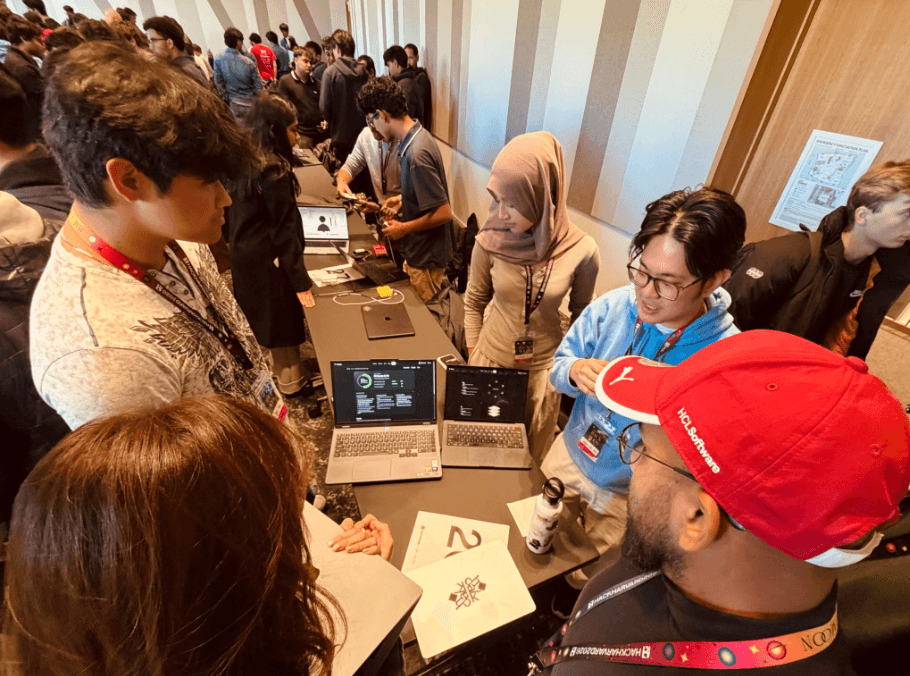
Chalk’s Challenge: build an agent on real data
Our challenge was the Best Data-Driven Agent Built on Chalk. We asked teams to build an agent that runs on real-world or contextual data, then show evidence that it does what they claim. Chalk supplied the building blocks:
- Sandboxes to safely house agents and execute around the clock
- AI Gateway for model access and trusted MCP tool access
- Federated Queries to pull data from real world sources
- Agent Evals to prove the agent actually works
Judges scored three things: impact, use of data, and how rigorously each team evaluated its agent. That last criterion shaped the weekend. Plenty of agents look impressive in a two-minute demo. Far fewer can show they make the right call.
The winning team took home $1,500+ in Apple Store credits, Chalk swag and interviews for our new grad role. The runner-up earned Chalk bags and sweatshirts, Hagoromo chalk and custom mechanical keycaps.
Results
First, congratulations to every team that participated. We loved seeing the range of creative, real-world use cases.
Our judges selected the winners based on the tangible impact of their builds and how well they demonstrated their agents on data that reflected real-world conditions. The results truly blew us away.
First place: Trace
"Fire moves with the wind, and now, so do the warnings."
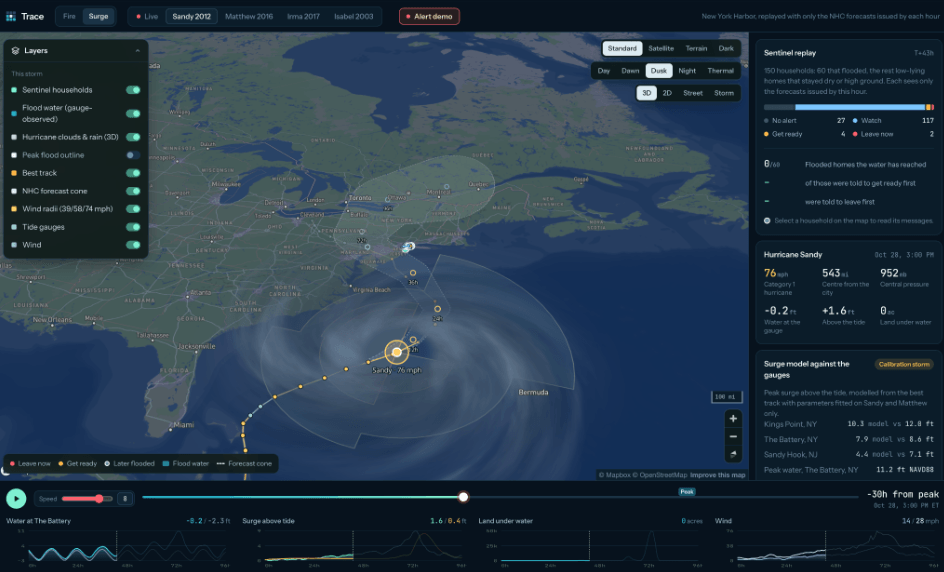
Trace is an AI disaster agent that warns each household before a wildfire or storm surge reaches it. It then texts or calls the user with precautions and the closest route to safety. Every 15 minutes it pulls live NASA satellite fire detections, fire perimeters, National Weather Service warnings, NOAA hurricane advisories, tide gauges, and wind and fuel-dryness readings.
How Trace used Chalk:
- Sandboxes: a Chalk sandbox runs the alert loop 24/7, with subscribers stored on a Chalk Volume. Other sandboxes host the web app and the text-and-call service.
- Fresh Data: residents can text the agent or call its phone line. mid-call, the voice agent pulls fresh data from Chalk, so its answers change as the fire does.
- MCP Gateway: the same agent is exposed as MCP tools, so anyone's AI assistant can ask about fire risk and routes and get the same answers as the texts.
- Model Gateway: every LLM decision, from alert calls to a message-quality judge, runs through it, allowing smart routing for the tougher decisions.
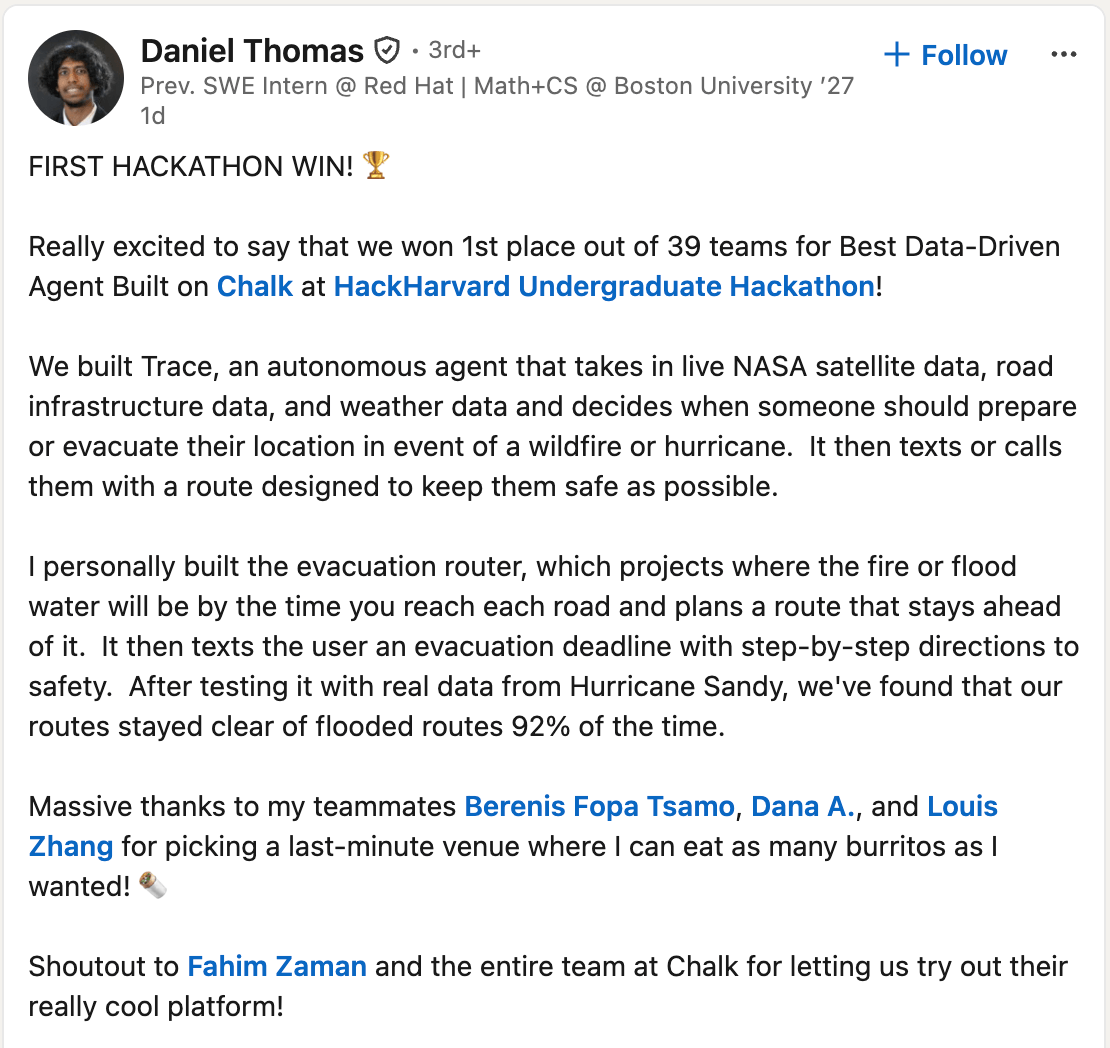
The proof: Trace replayed 600 households using only what was known at each hour, with no hindsight. It warned every home that was destroyed, a median of 8.7 hours ahead. The team used about 150 vCPU-hours across sandboxes, functions, scaling groups and the MCP gateway.
Team: Daniel Thomas, Berny Ft, Louis Zhang and Dana Abousharbin.
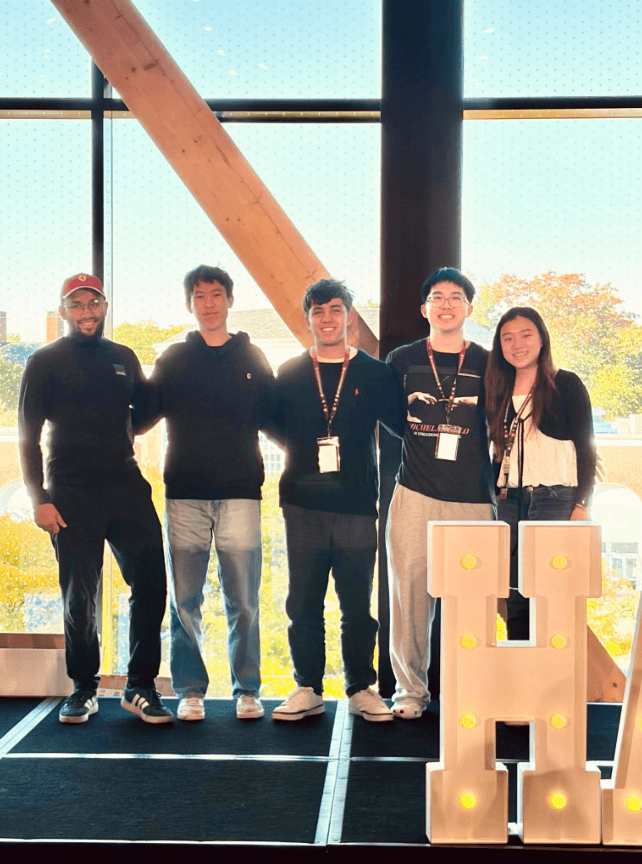
Runner-up: FEEL
"The room, in your palm."
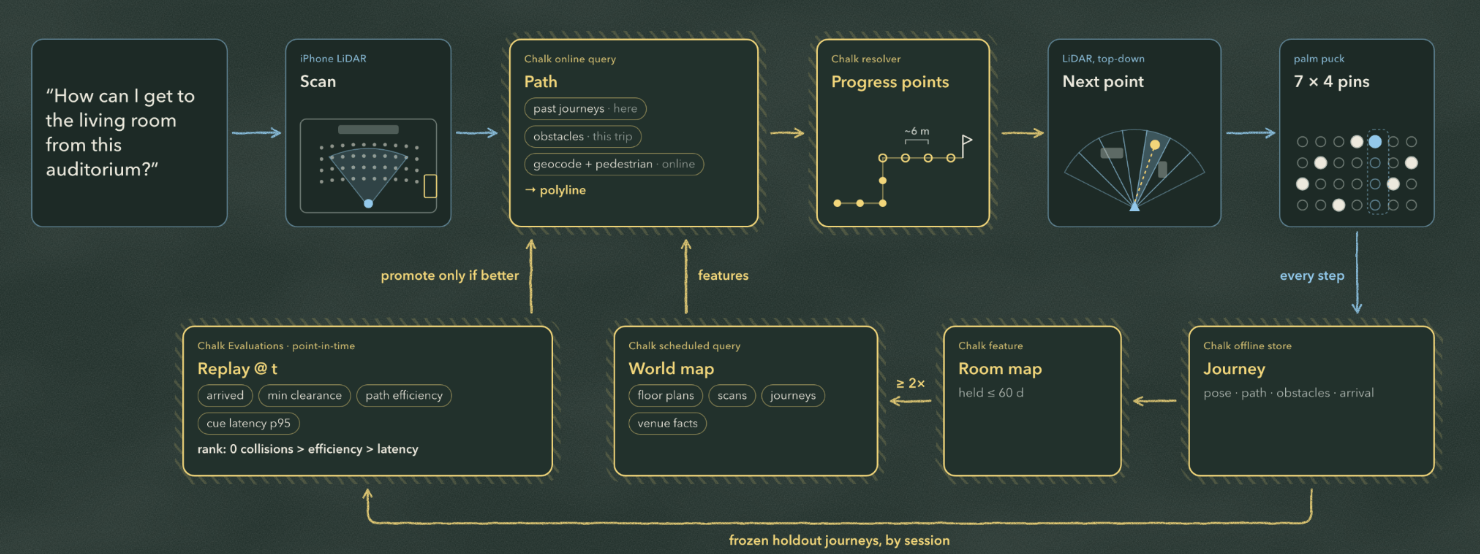
FEEL is a prototype designed to turn a room into touch for blind users. A LiDAR-equipped iPhone connects to a palm-worn puck with 24 pins. Ask “where’s the exit?” and it’s designed to indicate the direction through tapping, without spoken directions.
How FEEL used Chalk:
- Model Gateway: the exit-finding tool sends a camera frame to a vision model through a locked-down key, limited to two models with prompt logging off.
- Online queries: a Chalk online query plans a walking path from the current scan plus past trips through the same building.
- Offline store: every step of every walk is logged, and each visit becomes a room-map feature kept for 60 days.
- Scheduled queries: visits merge into a shared map that keeps only what at least two visits agree on, and that map feeds the next path.
The proof: FEEL scored its vision tool on labeled photos and weighted false sightings most heavily. For someone who can't double-check, a confident wrong answer is worse than no answer at all.
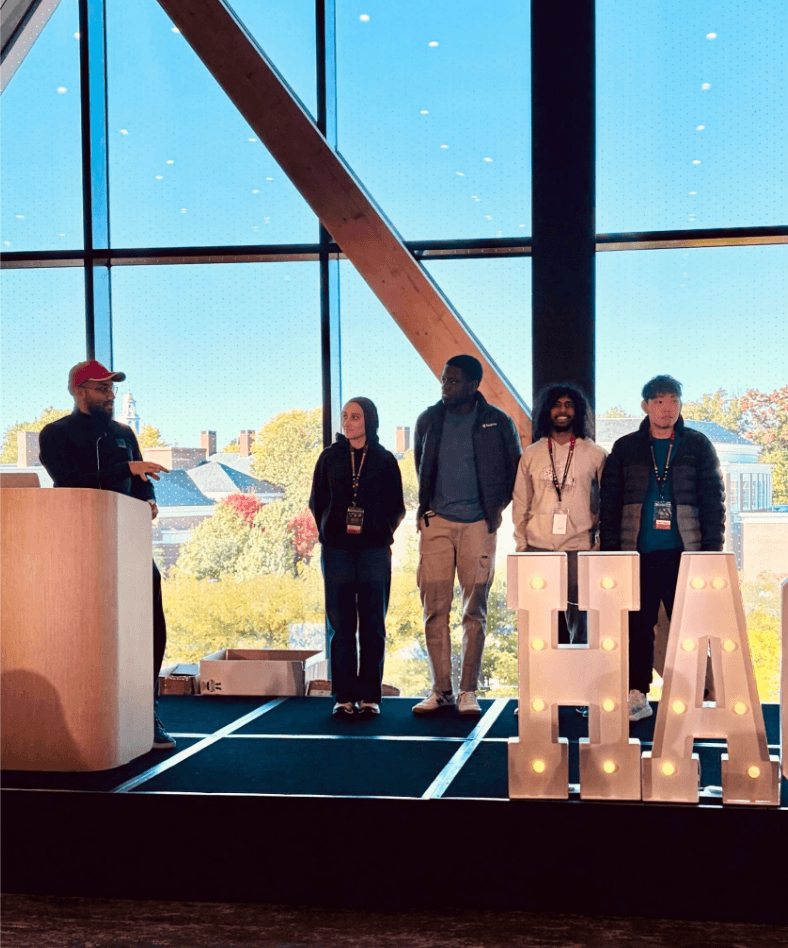
Team: Isabella Chen, Ethan Chen, Martín Ezequiel Pulitano and Benjamin Liu.
Honorable mentions
We’re sharing a few more favorites as inspiration for how you could use Chalk in your own apps.
- Rubber Ducky. An AI math tutor that shares a whiteboard with students, asking questions, offering hints, and drawing explanations. Their live demo ran on a Chalk scaling group. Try it in your app: host your agent and its interface together on a scaling group, so the thing you demo is the thing you ship.
- Antibody. Antibody finds security flaws in web apps, generates patches, and tests the fixes. It uses Chalk resolvers to score live requests and a scaling group to host its orchestrator. Try it in your app: turn request activity into a decision to allow, slow down, or block a sensitive action.
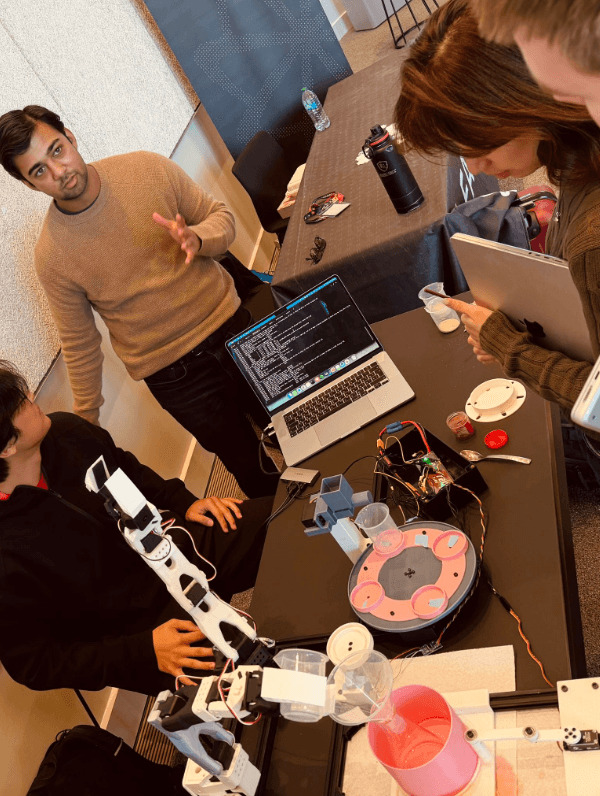
- LOOK. An eye-controlled robotic arm designed to help people with limited mobility pick up objects. Its Chalk integration uses features and online queries to help rank objects based on daily routines - for example, a mug in the morning and a water bottle in the afternoon, demonstrated with synthetic history. Try it in your app: combine a user’s current input with past behavior to personalize suggestions, while keeping the final choice with the user.
Put your agent to the test
In 36 hours, these teams turned ambitious ideas into prototypes and tested the decisions that mattered. Their work offers a starting point for your own app: choose a problem your users care about, connect the data your agent needs, and measure whether it gets the result right. Chalk gives your team the tools to keep building, testing, and improving, from your first prototype to production in your own cloud.
Build your own data-driven agent with chalk