

We spent last week at The AI Conference 2026 in San Francisco meeting with teams building across the AI maturity spectrum. Recent AI entrants wanted to hit the ground running with plug-and-play agent builders to support their products.
Companies already using AI in production approached us with different concerns: they asked us about accuracy, affordability, and safety under concurrent loads. The questions changed depending on where teams were in their AI journey. But once teams reached production, the concerns were consistent: context, cost, and control.
Common ways agents can fail
Teams in production brought up four common deployment pain points:
- Quality degrades and agents hallucinate. This happens when agents try to reason on outdated features. Chalk’s real-time context engine ensures that agents only act on what’s true at decision time.
- Agents miss context or retrieve the wrong information. Sometimes agents have too much information to reason over instead of guidance about what data matters to make a decision.
- Costs spike when agents repeat tool calls or waste reasoning loops. For teams working at scale, wasted agent reasoning loops are too expensive.
- Agents access tools or data they shouldn’t. Heavily-regulated industries require safeguards so they can test and deploy agents that enforce data permissions and user privacy.
These are the problems we built Chalk to solve. Production AI needs real-time inference, supported by one definition of your data and temporal consistency.

Signaling production readiness
The most interesting conversations weren't about whether agents can work. They were about how to make them work reliably within an organization’s specific requirements, constraints, and guardrails.
They asked whether Chalk delivers context at prompt assembly or through a tool call, how we would deploy to an on-prem stack, and how low-latency context reduces wasted reasoning on private models.
Discussions are moving beyond the inference architecture that has been top of mind for the last few years. Teams are more interested in control than agent deployment or performance. They want to know who owns the data, selects the models, governs the context, and ultimately stays accountable for an agent’s decisions.
What an agent stack needs
Attendees were curious about managing agent context and governance in one system. Conversations drifted toward the same set of production features:
- Real-time context delivered at decision time
- MCP tool-call governance
- Evals that run on the same data production sees (or would’ve seen)
- Observability that goes beyond traces
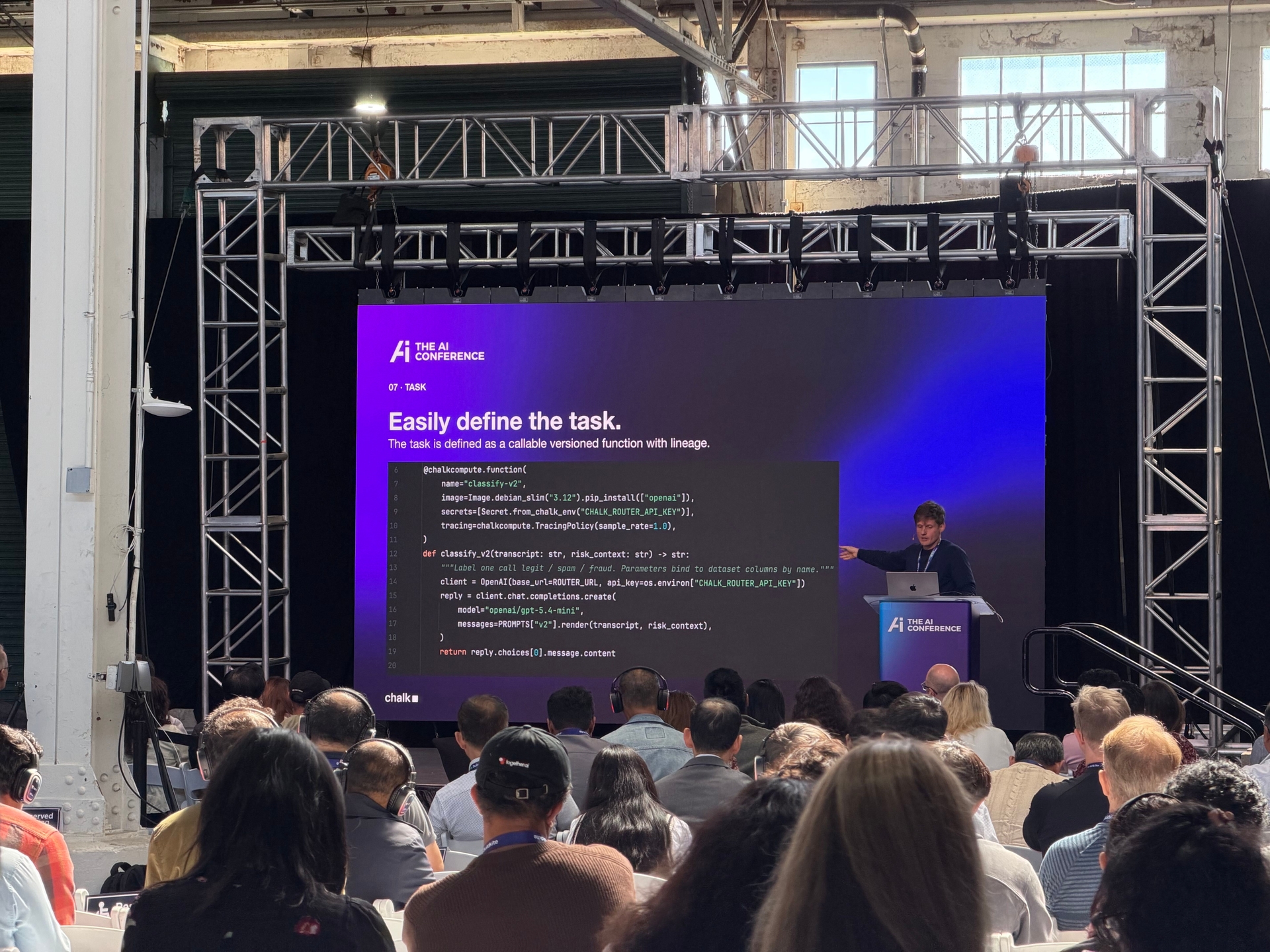
Our Co-Founder, Elliot Marx, dove into how Chalk built these features during his session at Pier 48. He shared why most AI failures that look like model or prompt problems are actually context problems with agents deciding confidently on stale data, and evals that can't predict production performance. A full house stayed to watch Elliot share an end-to-end workflow for shipping agents with a context layer and deploying them in a sandbox.
Own your intelligence
The AI maturity curve is getting shorter. Newcomers joining the fray daily show how much interest there is in expanding the use cases for models and agents. After they get set up, production AI teams turn their focus to building infrastructure that improves performance and cost-efficiency.
That’s where Chalk can help. Elliot will host a live session on October 8 that will show you how to turn data into actionable context for your agents at decision time. Own your intelligence with a single system that powers testing, evals, and production, so you can deploy agents with confidence.